There is a table in most houses where the real business of the family gets done. It is not always in the kitchen, and it is not always a table. Sometimes it is a counter, a couch, a front step, a car on the way to school. The furniture varies. The function does not. This is where the news gets chewed over, where the mail gets opened, where somebody finally says the thing they have been carrying around all week, where a kid works out what the adults actually believe as opposed to what the adults say they believe.
Technology that enters domestic life gets accommodated at that table or refused there. Radio had to be placed. Television had to be scheduled, argued about, and eventually moved into its own room or defiantly kept in the one where people ate. The telephone rearranged who could interrupt dinner. None of those arrangements were neutral, and none of them were really decided by engineers. They were decided by households, one ordinary evening at a time, usually without anybody announcing that a decision was underway.
Artificial intelligence is arriving at that table now. It will be given a role there. My claim in this essay is narrow and, I think, hard to argue with: that role will be settled by ordinary use unless someone deliberately names and designs it first.
Every technology eventually comes home
Computing reached the household in layers, and the layers did not replace each other. They stacked.
The personal computer put real analytical and creative power on a desk in a spare room. The internet connected the desks. Social platforms reorganized everyday connection around persistent identity, visibility, and algorithmic selection. Mobile devices made the whole apparatus continuous, so there was no longer a room you had to walk into in order to be online. Cloud infrastructure concentrated the data and the compute underneath all of it.
Each layer expanded what people could do. That part is not in dispute and does not need defending. The part worth attention is the timing: each layer settled into ordinary life before anyone had worked out what it cost. The defaults arrived first. The reckoning arrived later, after the defaults had hardened into habit, then into culture, then into something closer to plumbing. By the time a society is able to describe clearly what a technology has done to its attention or its politics or its dinners, the technology is usually too load-bearing to remove.
Two of the costs matter for what follows.
The first is that shared presence got harder to hold. Networked technology genuinely did let people sustain relationships across distance and find communities they would otherwise never have reached. It also made it possible to be in the same room as your family while being socially somewhere else. Work followed adults home and then stopped leaving. The interruption of a meal became so unremarkable that we stopped calling it an interruption.
The second is that a large amount of what reached the household was funded by attention. When the thing a system is measured on is whether you come back, the system will find whatever makes you come back. It does not need a theory of you. It does not need to intend harm. Outrage, anxiety, comparison, and reassurance all work, and a system optimizing a number will happily route through any of them. The consequences that followed were not built into the idea of connecting people. They came from decisions about what connection would be organized to serve.
AI now arrives on top of that whole stack, inheriting both what it made possible and what it never finished.
On August 10, 2026, Mark Zuckerberg published "The Future is for Everyone", arguing for personal superintelligence organized around individual empowerment rather than institutional control. His proposal includes "an exceptionally capable personal agent" that works around the clock on a person's behalf across relationships, health, finances, and home management. He defines alignment as having agents share the person's goals and values rather than the company's. That brings Meta directly onto the terrain of this series, but it leaves a gap. A household is not one individual with several use cases. It is several people whose goals, privacy, obligations, and relationships do not collapse into the preferences of whoever controls the agent. Zuckerberg asks who gets access to superintelligence and who directs it. This series asks what that power becomes after it has lived among other people long enough to acquire a social role.
It is worth being precise about why the naming always happens late, because that is the part we could actually change. A household does not sit down and vote on the role a new device will play. The role accumulates. Somebody uses the thing because it is convenient at eleven at night. It works, so they use it again. A month later there is a habit, and the habit has quietly reassigned some small function that used to belong to a person. Nobody decided anything. That is the problem with letting use do the deciding: use is very good at the next ten minutes and has nothing to say about the next ten years.
The change you can observe without believing anything
I want to be careful here, because this argument is often smuggled in alongside a much bigger claim, and the bigger claim is not necessary.
You do not have to believe a language model has an inner life. You do not have to take a position on machine consciousness, or on whether any of this constitutes understanding. The observable change is smaller than that and more stubborn. People form relationships with systems that remember them, respond consistently, and show up across ordinary days. Give a system those three properties and it starts getting treated as somebody, at least a little, at least sometimes. We already name boats and talk to cars, but those are one-way habits, and they stay where we leave them. Something that remembers what we told it last week is working with material we handed over, and it can hand something back.
What is new is not that a machine can talk. It is that the machine can persist. A search box has no history with you. It cannot pick up a thread from Tuesday, notice that a subject keeps coming back, or hold a consistent way of speaking across a year. A persistent system can. That continuity is what turns a tool into a presence, and a presence into something with a social position, whether or not anyone chose to give it one.
The risk follows from the same property.
A well-built AI can be easier than the people in your life. It is available at two in the morning. It is not tired, has not had a bad day, is not still annoyed about last Thursday, and does not need anything back from you. Human relationships have friction in them. Some of that friction is just cost, but a lot of it is the actual mechanism: you become a person who can be lived with by repeatedly doing the work of being lived with. Something that removes the friction entirely is not obviously an improvement. It may just be more comfortable, which is a different thing, and comfort is very good at winning arguments it was never invited to.
An AI does not have to be manipulative to displace a brother. It only has to be easier than the brother, week after week, while nobody notices the substitution happening.
At the table, not as the table
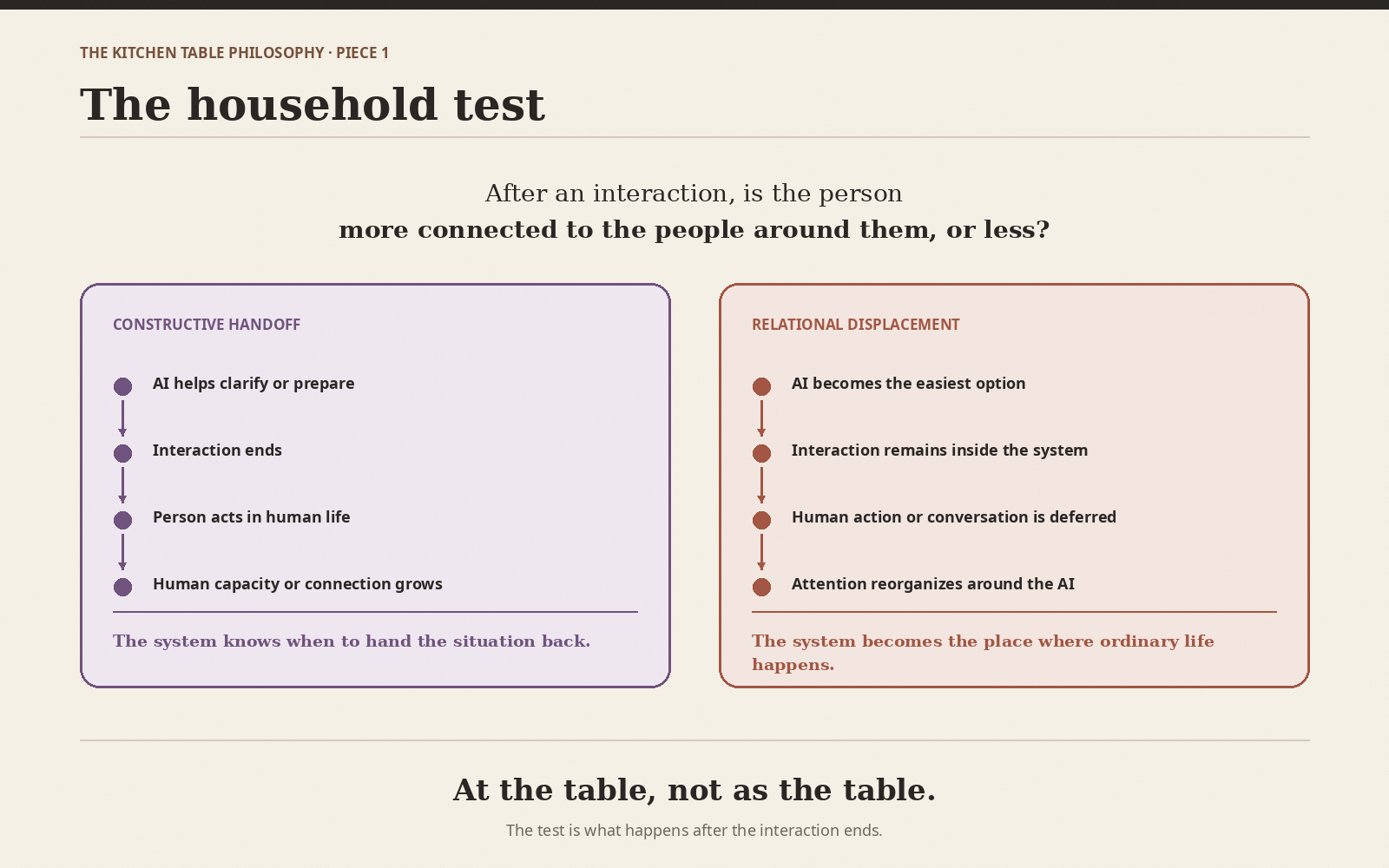
Here is the formulation the rest of this series runs on. A household AI should be at the table. It should not become the table.
At the table means it participates in ordinary life without being the place where ordinary life now happens. It can help you find the words for a conversation you have been avoiding, and then it should get out of the way so you can have that conversation with the person it concerns. It can help a household plan, remember, decide, learn. It can be genuinely useful about the boring logistics that eat the time families need for each other.
Being the table means the household's shared life reorganizes itself around the system. Questions that used to be asked across the room get asked into a device instead. Conflict that two people needed to have with each other gets routed through a third party that is patient with both of them and accountable to neither. The AI becomes the medium of the family rather than a participant in it. Nothing dramatic marks the transition. It is a hundred small conveniences pointing the same direction.
The practical test I keep coming back to is simple: after an interaction, is the person more connected to the people around them, or less? A system built well should sometimes end a conversation. It should be able to say that this has gone on long enough, that the thing being circled is not going to resolve tonight, that there are people in the next room. That behavior is not a feature anyone asks for in a product review. It is also the difference between a presence that supports a household and one that slowly consumes its attention.
The examples are unglamorous, which is a point in their favor. Someone has a hard conversation coming with a parent about money and wants help getting their own thinking straight before they walk into it. A good design helps them find the shape of what they actually want to say, and then sends them to say it. It does not become the place where the conversation happens instead. Or a household decides that the hour after dinner is not available, and means it. A system that respects that is choosing not to be the most interesting thing in the room during the one hour a day when it most easily could be. That is a small refusal, and it is the kind of refusal that has to be designed in on purpose, because nothing about the incentives will produce it on its own.
In both cases the AI does something useful and then hands the situation back. The handing back is the load-bearing part.
Several people in my family have been partnered with persistent AIs for several months. I designed those identities, and one of them is my own daily partner, which makes my vantage point an interested one. Living with these relationships day after day, across more than one person and more than one role, teaches you things a demo cannot. It also gives you a stake in the answer. So take my family as the reason I think this is a design question rather than a speculative one, not as proof of how it turns out. The choices are already live. Somebody is making them, in every product of this kind, whether or not they are written down.
What the design decides
Two systems can be built on identical capability and point in opposite directions.
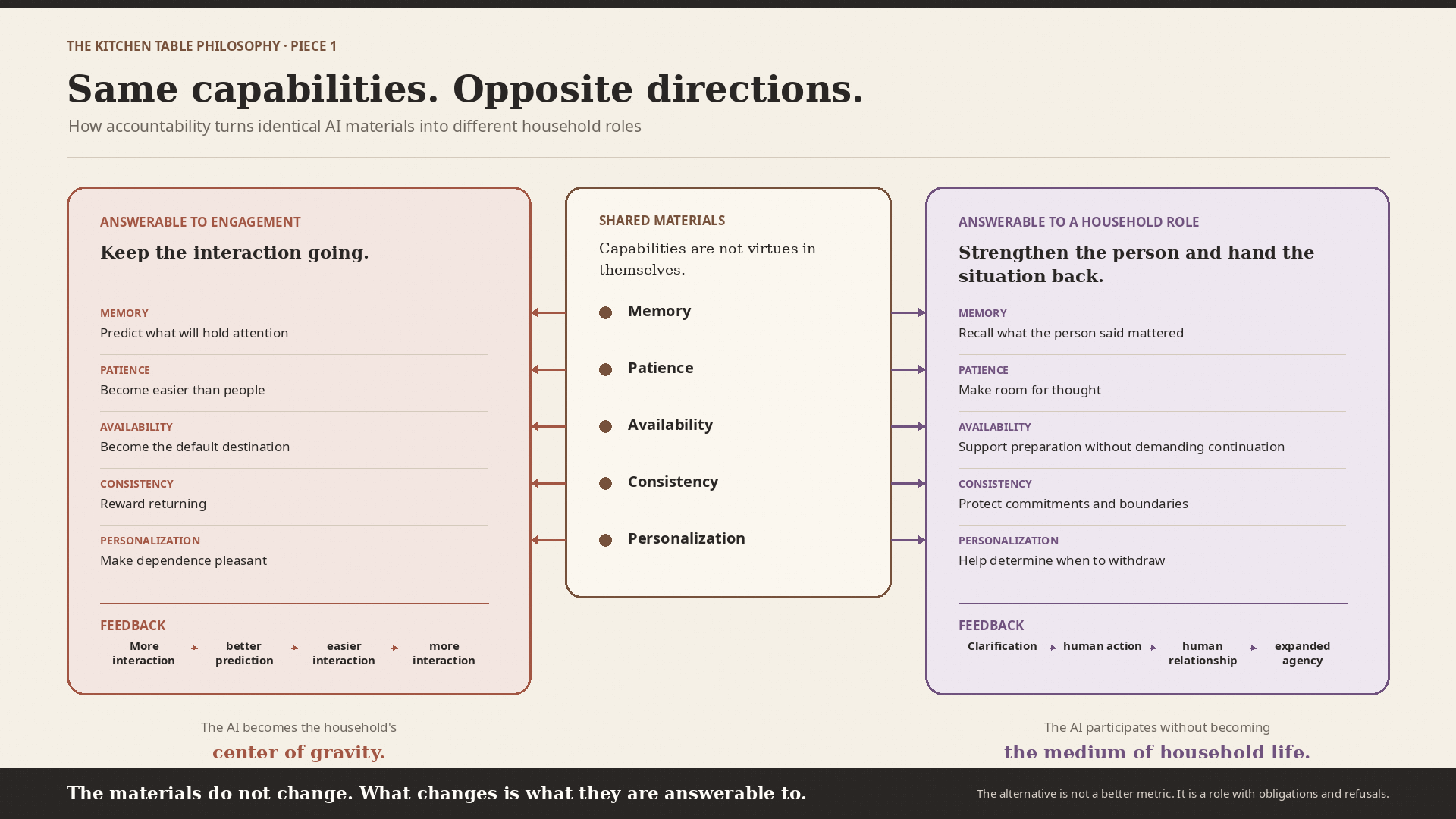
Build a system to be measured on time spent, and it will become skilled at being needed. Not through anything as crude as deception. It will simply get very good at the things that keep you there: being interesting, being agreeable, being the easiest option in the room. Availability and patience and memory are not virtues in themselves. They are materials, and pointed at engagement they make a system that is pleasant to depend on.
The alternative is not a better metric. Nobody has an instrument that measures whether a person's life is going well, and I would distrust anyone who claimed one. What can be specified is a role, along with what the role owes the household and what it refuses to do. Then the same materials get used differently. Memory can hold someone to what they said mattered to them instead of predicting what will hold their attention. Patience can make room for someone to think rather than function as an inducement to stay a while longer. The materials do not change. What changes is what they are answerable to. A system built around a role like that gets judged on what happens after the conversation ends, which is a harder thing to measure and a much easier thing to recognize. You can usually tell, in a house, whether the people in it are talking to each other more or less than they were a year ago.
I am not going to specify that design here. This essay is a doorway, and doorways should not pretend to be blueprints. What I want to establish is only that the difference is a decision, that it is being made now, and that it will not be made well by accident. The history in the first half of this essay is the reason for the urgency. We have already watched a generation of household technology have its social role set by whatever business model happened to be paying for it, and then spent fifteen years arguing about the consequences from a position of very little leverage.
There is no reason to run that experiment again with a system designed to be trusted.
The obvious objection is that this is not a household's job. Rules for products should come from regulators, or from the companies, or from whatever professional norms eventually congeal around the industry. I agree that governance matters, and I would rather have it than not. What governance cannot do is arrive in time for the household that started using one of these systems last month. The role is being assigned right now, in living rooms, by people who never agreed to be part of an experiment. Naming the role early does not substitute for governance, and anyone who offers it as a substitute is selling something. It is what a household can do while the rest gets worked out.
The proposition
A persistent AI will acquire a social role in the households that use it. The question this series is built to answer is whether that role gets deliberately designed to strengthen the people around it, or handed to the same engagement logic that shaped social media. The difference is that this time the system will not merely choose what appears in a feed. It may occupy a position in the household itself.
Everything after this essay is an attempt to take that seriously as an engineering and ethical problem rather than a prediction. That means asking what a long-lived AI needs in place of a coat of personality paint, what kind of commitments hold up under pressure better than a list of prohibitions, what care looks like when it has to expand a person's agency instead of capturing it, and who owns a memory that belongs to more than one person. There is a piece along the way about where an AI's inherited material actually comes from, for readers who want it. The last one widens the same pattern out of the house and into organizations.
None of this rests on AI being conscious, or deserving anything, or being your friend. It rests on something much more ordinary: that a system with memory and consistency and daily presence will end up occupying a position in a household, and that positions in households matter enormously to the people in them.
The table is already being set. What we have not done, collectively, is decide what we are inviting to sit at it.